An in-depth examination of the physical, social, and scientific aspects of Auroville’s agriculture, looking ahead to the conscious participation with Nature that the Mother envisioned.:
Originally published March 14, 2026
From the day of our birth we must eat if we are to survive and this continues for the rest of our lives. Without sufficient healthy food it is very difficult, if not impossible, to become a healthy adult. Healthy food is a basic need for a healthy human body from which all our other human characteristics develop and express themselves.
Everything we eat comes from the Earth and every time we eat, we have a connection with the Earth whether we are conscious of this or not. Yet the connection between our food and the earth from which it comes has become increasingly complex. In these times, whether we eat healthy or not depends on whether we can afford to pay for the food we need. This is being determined by a wide range of factors, including global and local economic, social, and food systems, all of which are underpinned by the capacity of the natural world. The majority of humans are living in ways that disconnect them from the Earth. This is being intensified by food becoming a commodity which can be accessed only by those with sufficient money. Rather than food being acknowledged and treated as a basic need required by everyone.
Auroville cannot isolate itself from these basic realities and individual Aurovilians cannot ignore their need for food. What does this mean for how our community should access food? Since part of Auroville’s vision is to be a self-sustaining community, growing as much of its own food as possible is an obvious component of this. This leads us to the further question of how this food should be grown and subsequently distributed, and for the case of Auroville in particular, a site of material and spiritual researches, how can we move towards a food system that acknowledges terrestrial realities while growing towards the higher consciousness it is meant to express?
Over the last five decades, Auroville has undertaken remarkable ecological restoration work. Alongside this, a network of community farms has taken root, supplying fruits, vegetables, grains, milk, and eggs to the kitchens of Auroville. The challenges in Auroville’s food system are similar to those around the world — lack of investment in key infrastructure areas, lack of labour and facilities for young farmers, lack of community-based solutions for distribution and processing, lack of farmer training, professional development, and community-wide commitment to food resilience, not to mention the increasing commodification of food, labour shortages, climate shocks, wildlife pressures, and financial strain.
In Auroville, we have the opportunity to cultivate a new kind of agriculture that not only addresses these growing concerns globally but shifts the perception of agriculture as a ‘business’ or a transaction with nature, towards a participatory interchange, a way of mutual action and growth. Developing a strong food system has a role to play in both — the evolution of consciousness, and building the City the Earth needs.
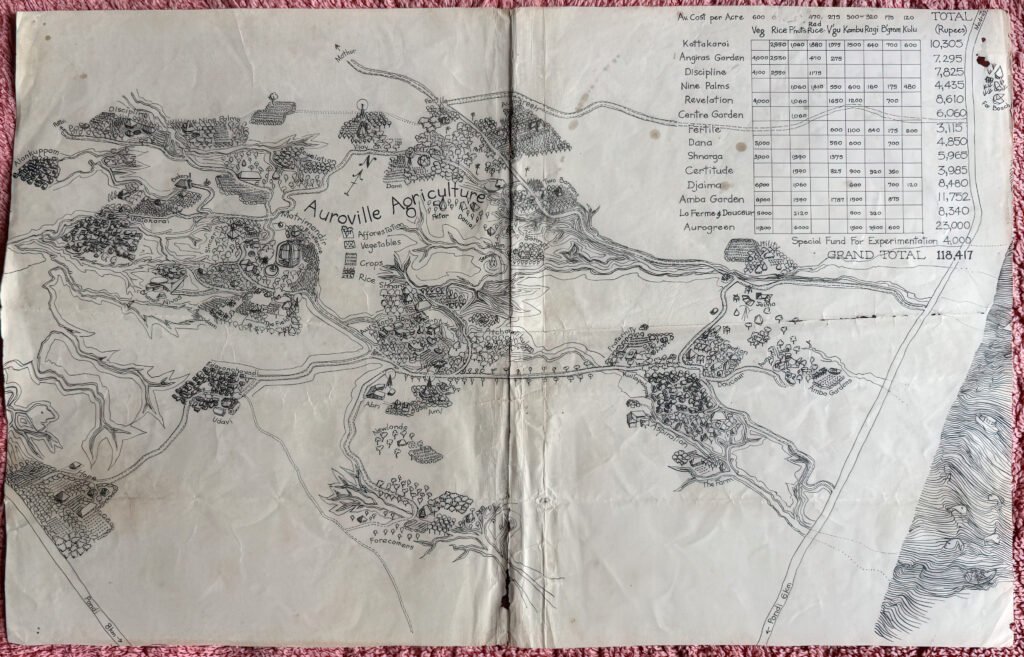
Dimensions of an integral approach to Auroville’s food system:
(1) The Physical Dimension
Modern industrial practices contribute approximately 30% or more of global greenhouse gas emissions — a footprint largely driven by the intensive use of chemical fertilizers, pesticides, and livestock waste, as well as the transport of food, and the food processing industry. While commercially lucrative in the short term, this model systematically trades long-term ecological health for immediate yields, leaving a trail of degraded landscapes and systemic biodiversity loss in its wake; we destroy the very foundation of what our food growing needs. This degradation creates a “chemical treadmill,” necessitating increasingly exploitative interventions to sustain production until the land reaches an inevitable breaking point.
Inorganic farming also has direct consequences for human biology, primarily through the bio accumulation of endocrine-disrupting pesticides that interfere with our hormonal systems. Furthermore, residual herbicides on produce can act as low-grade antibiotics, disrupting the delicate balance of the gut microbiome which is foundational to our immune and inflammatory responses.
In this light, conscious farming is not just an ecological imperative but a biological necessity for any meaningful terrestrial transformation. It is a commitment to the integrity of the Earth and everything on her which is intended to support a higher consciousness.
(2) The Vital (Social-Economic-Behavioural) Dimension
A healthy farm cannot be healthy only ecologically. It must also address people’s welfare, and the sovereignty of food production. Concerning economical factors, can we aim at efficient, healthy and responsible processes of producing and processing food and then see what that economically means? From there we can see what the true cost is to produce safe and healthy food for the community.
These considerations raise an important question: What is our collective relationship with food, food production, and farming?
An assessment of Auroville’s farms (2024) showed that the shortfall in community-grown food is not only a matter of production. It is also shaped by distribution systems and consumption patterns. Our collective vital preferences—what we desire, choose, and expect — strongly influence what is produced, what is distributed, and ultimately what becomes economically feasible to grow. At the same time, there is often a disconnection between these preferences and the on-ground realities of land, seasons, labour, and ecological limits.
In this sense, Auroville too is at risk of falling into the wider societal habit of monetizing and commodifying food. Prices of vegetables and fruits have become points of tension and negotiation between farmers, distributors, and consumers. This reflects a broader lack of engagement by the community with the food system, and a corresponding absence of administrative clarity to organise food production as a collective responsibility — where economics becomes a tool of sustainability rather than a means of accumulation. The more disconnected we become from farming, the more our vital preferences drift away from the physical truth of the earth.
Closely related to this is the question of livelihood. Very few young Aurovilians are drawn toward farming today. Much like elsewhere, the ancestral and cultural connection to agriculture is fading. Only a few decades ago in India, farming was deeply woven into social life, with festivals and rhythms organised around land and seasons. Today, many of us relate to food mainly through supermarkets — or, in Auroville, through distribution centres such as PTDC and PTPS. A generation is growing up with the impression that food simply “comes from shops.” Fewer people and communities are investing time, energy, and resources in community gardening and food-related social activities. Food, apart from occasional social meals, is becoming less a living part of our shared community culture.
Agriculture in Auroville therefore, asks something deeper of us: how do we cultivate a vital life that is grounded and disciplined by the physical? How do we develop a healthy relationship between what we want, what we consume, and what the Earth can sustainably provide?
These are questions each of us has the opportunity to explore — not only for Auroville, but as part of a larger human dilemma. Community farming here becomes a rare living laboratory: small enough to engage with directly, yet complex enough to mirror global food challenges, and to pioneer more conscious solutions.
(3) The Mental (Scientific) Dimension
With the rapid advancement of artificial intelligence, mechanisation in agriculture is becoming increasingly inevitable. Much of agricultural work is likely to become more mentalised in the future, driven by robotics, automated systems, and data management. In the outside world, the trend is towards efficiency at the cost of ecological sustainability and social fairness.
Care farms exist in different parts of the world, where people with different kinds of issues work on farms to connect with nature and it’s a healing thing. Organic farming is being recognised as a healing activity in other parts of the world. In Auroville we can invest in this perspective a bit more especially for people with mental health issues or neurodivergence.
If Auroville wishes to influence how agriculture evolves in the future aligned with its values and aspirations, Auroville farmers will need to actively cultivate mental and technical capacities related to emerging technologies. Without this shift, there is a real risk that Auroville farmers may fall behind—becoming inefficient and losing economic competitiveness in relation to the larger market.
Additionally, if there is a case to be made for conscious utilization of advanced technologies integrated with Artificial Intelligence (AI), Auroville is well poised to pioneer this discovery, as a community aspiring for the evolution and integration of diverse consciousness frameworks.
(4) The Interconnectedness Dimension
Human unity is a central pillar of Auroville’s purpose. However, the aspect of human unity that gets discussed the most is the communal unity, the unity between humans. Agriculture is the praxis of unity of humans not only with other humans but also with all beings. We, as a community, are all anchored in this land, and our work with the land goes beyond material sustenance — it is an opportunity to develop a new relationship with the land — the physical body of Auroville. The spiritual dimension of agriculture ties us all (farmers or not) in the culture of the land (agros: land) and requires us to synchronise ourselves with the rhythms of nature and re-establish our lost connection with the Earth mother. This makes agriculture– spirituality in action, one of the unique ideas of Integral Yoga and the core of Auroville’s purpose. Agriculture offers an antidote to our currently excessive and ungrounded mental culture — an embodied spiritual experience, a closer contact with the ‘deeper self’, and offers opportunities for education and learning to farm beyond the techniques of growing food. Agriculture in Auroville is important for the newcomers to re-live the spirit of Auroville — of spiritual manifestation in the matter.
In conclusion
The externalities of our current world and the breakneck speed of our lives and communication keep us away from any opportunity to recognise our predicament and articulate a response to it, and in this rush, we are experiencing a pandemic of inner disconnect, loss of meaning, relationships and purpose. It seems that more and more people are turning to Auroville for experiments in sustainable community solutions, and more importantly for the ecological and social environment to reflect deeply on their own lives and journey. Many of these people eventually commit to the community. Auroville farms have been a fertile space for many such people to connect back with the land, with the soil, with food and their bodies.
Auroville agriculture cannot only be about the tonnage of food and organic certifications. Through agroecology and ethical stewardship, the conscious partnership with Nature that Mother envisioned can be a tangible reality, and developing our food system offers a way to ensure that our bodies are nourished by food grown consciously, inviting it to grow into an increasingly refined instrument to hold an ever-vast consciousness. Auroville’s history of land regeneration and its unique diversity of soil profiles and farming techniques offer an unparalleled laboratory to experiment with this essential evolution. Auroville farming is both a study and an experiment in discovering how this can be realised.
By the Food System Envisioning group
Amy, Anshul, Arul, Aumurto, Deven, Isabelle, Manas Arvind, Nicole, Nidhin, Pavan, Priya, Tanisha, Tomas, and Elisa (facilitator)
Originally published as a community update 14 March 2026