A group envisioning Auroville’s food systems recounts how they started as early as 1969, and went through multiple methods of distribution, financial maintenance, organisation, and connection between the farms and residents.
For the past year, a group of Aurovilians have been meeting regularly in order to address challenges on Auroville’s food system that have become more visible in recent years, and to envision a new system that improves the interconnectedness between the community, food and farmers of Auroville. This article is the second in a series of our reflections and aspirations, to continue to nurture a space for conversations on food and farming in Auroville. The first article was about why we grow food in Auroville and the different dimensions of agriculture, which you can find here.
In order to have a grounded understanding of the system we currently have, it’s essential to look at the context and the history in which it emerged. Ecological realities, economic necessities, social contexts and inner aspirations don’t often align. How did we try to align these in the past? What decisions and creations emerged as a response? In what ways are the questions we are facing today different from those 30, 40, 50 years ago, in what ways are they the same? What are we carrying from the past which doesn’t work in the present anymore?
How it all began
Farming in Auroville began with the beginning of the community itself, in 1969. Most residents were involved in food production out of necessity, an effort that spanned both established farms and various kitchen gardens throughout the community. Initial farms in the 1970s included AuroOrchard, Service Farm, AuroGreen, Kottakarai, and Revelation, and by the 1980s included Annapurna, Discipline, Djaima, Fertile. They grew seasonal fruits and vegetables, crops like peanuts, ragi, gram, varagu, ulundu, red rice, sesame, and some had dairies and poultries.
Where are our kitchen gardens today?
Is there one in your community? If yes, how is it going, and if not, do you know why? What can we do today to create a deeper reverence for what feeds us?
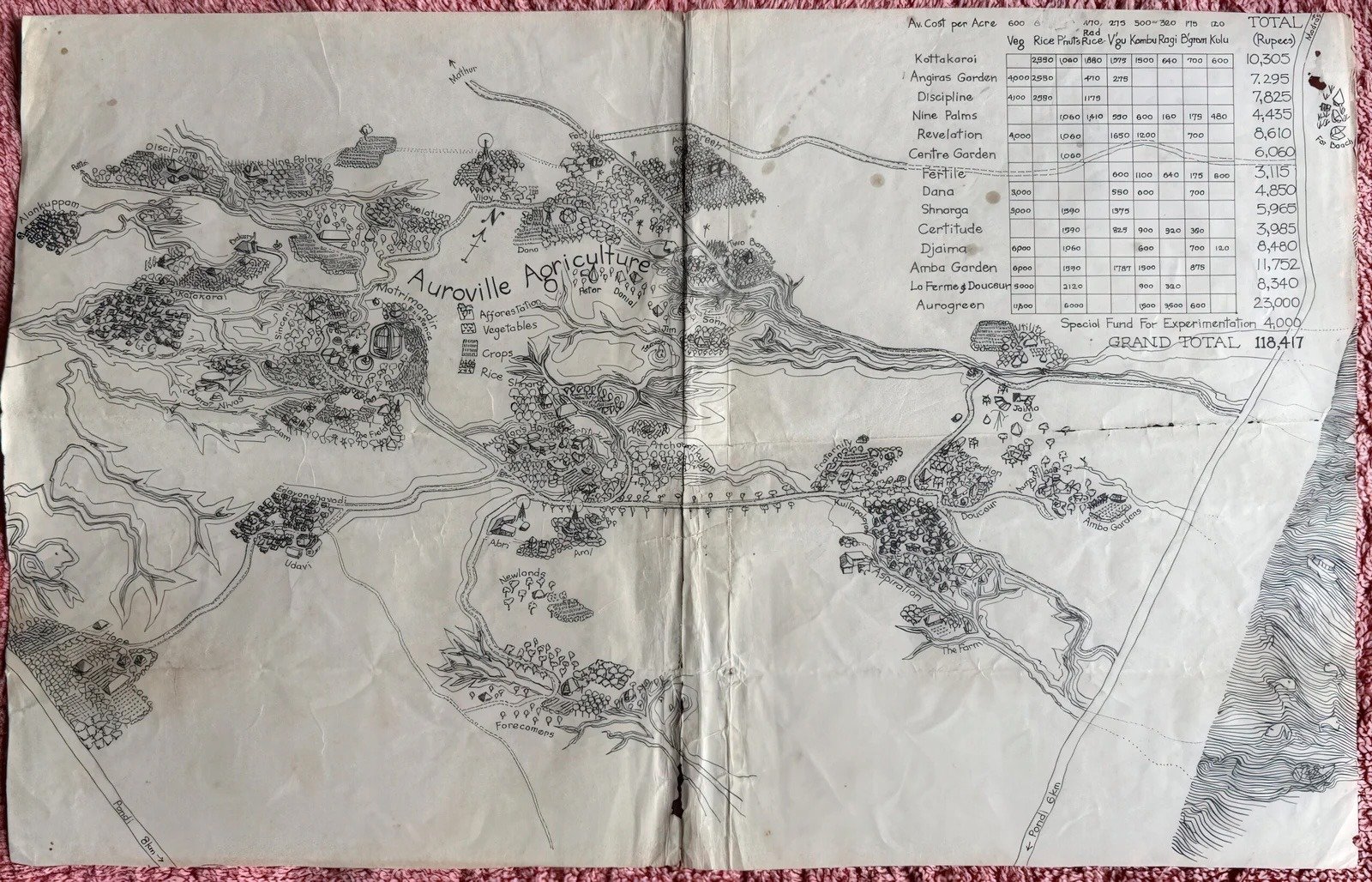
Click map to view larger version
Auroville has 26 farms today.
Do you know where they are?
Central Food Distribution Centre and Pour Tous:
In the 1970s, Auroville produced snake gourd, green papaya, tapioca, pumpkin, and beans, and some food was of course sourced from Pondicherry. However, it was considered essential for the community to adapt to affordable local crops in order to survive. Pour Tous fund was the first community fund, created 1st January 1976. It received donations and maintenances (Rs. 125 / month) from the Sri Aurobindo Society (SAS). A spirit of collective endeavor led to the creation of a Central Food Distribution Centre where today we have Udavi school, and subsequently the opening of Pour Tous near Aspiration Community on February 28, 1974. When SAS took away the maintenance for Aurovilians, Aurovilians stepped up within a week, and organised to bring everything that they had for collective distribution in order to survive. Everything was shared equally in baskets to be delivered to each community roughly every alternate day. The historic Pour Tous meetings, the first regular resident meetings, were held around bags of potatoes and tomatoes, and a recurring topic was — how and what do we eat. Food and governance were the same thing. The “Envelope” system started in 1978 — a method of budgeting modelled after the Mother’s management of ashram finances, and an envelope of donations/collected funds named “Pour Tous” was used to purchase food for the collective.
In the late 80’s / early 90’s, the baskets of Pour Tous gave way to a stall where individuals came to purchase what they wanted. What was originally designed as a system to ensure our needs are met collectively and our resources pooled had to evolve to serve the emerging reality that people wanted the food they could afford with their own means, irrespective of what the collective could afford. People fought over sticks of butter. This was an interesting point in our history. As our means increased, we became more Individualistic.
Today then, when the goal of food self-sufficiency is less about surviving and more about thriving, how sincerely are we asking ourselves of our “needs” in the food we eat?
How responsibly are we living this question collectively, how courageously are we walking towards this goal when it no longer looms over us demanding us to walk it?
In this stall, one had to point to bin from behind a counter and request apples, bananas, potatoes, papayas, while someone else would pick the item and put it on a scale. This was of concern to some people — they wanted to connect, to touch, to feel the beetroot, the watermelon. It was only in the early 2000’s that Pour Tous set it up so you could pick your own produce.
What is your direct connection to the food you eat?
Do you want to choose it yourself?
Do you have a way of picking a watermelon?
How concerned are you about how your pumpkin looks?
Food Growing Cooperative, and the Pondy market:
In 1978, we witnessed the first attempt at formal organization of AV farms in a Food Growing Cooperative consisting of thirteen farms. It operated through a dedicated envelope which was used for growing food that provided farms with budgets. The Cooperative received the produce sales revenue in return, but the idealism of the envelope system struggled as the population grew. The cooperative collapsed in 1983, as did the envelope system in 1984. In its place, individual accounts were created and farmers went back to operating on an individual basis.
A major crisis befell the food system when in the 1990’s the Tamil Nadu Electricity Board decided to discontinue their inclusion of AV in their policy of providing free electricity to farmers for pumping. This had a major effect on our largest farms at the time — AuroOrchard and Aurogreen — which were forced to downsize operations drastically over the coming years. Food from the Pondy market thus offered an effective backup for our needs.
Today, this backup has turned into the primary option to meet our food needs. This is in large part due to our unadapted preferences to our local reality — a problem 50 years old that we have been unable to address as yet — but also due to its cost effectiveness, or rather, its hidden cost — our health. Knowing that the food from the Pondy market, like in every market, is grown using chemicals by farmers and workers in a hostile economic system, we must ask if we care about creating a different economy grounded in conscious choices, preferences and needs.
How do we nurture this aspiration today?
How do we support Auroville’s farms?
How enthusiastically do we offer our participation in our food System?
Farm Group, more organised finances and processes:
The farms of Auroville organized themselves on a large scale again use of available assets, to set up financial processes, and to definepolicies collectively for land development. Farmers began to receive a maintenance from the Central Fund to ensure their own basic needs were looked after as they worked to produce food for the community. A common granary (now called Auroville Grains) was established in 2011 at Annapurna to process the grains grown in Auroville and ensure quality, storage and steady supply throughout the year. Subgroups within the Farm Group of dairy, grain and vegetables and fruit subsequently emerged to share knowledge, take decisions collectively, raise funds, etc.
Direct Baskets from the farms
Across the world, there is a growing concern about people losing connection with their food. To address this gap, some farmers have started offering baskets directly to community members and have direct communication with the consumers. Annapurna and AuroOrchard send out a link every week by email and Whatsapp where people can order and receive their baskets at Foodlink or outside PTDC. Terrasoul hosts a market every week where people can visit and buy fresh produce. The intention of some farmers remains to be in intimate contact with consumers, to share how the food is grown, the joy and the challenges that we face as a community in covering our nutritional needs. Others are less visible but produce food for the community on a daily basis, which is available at Foodlink.
Would we like to have more farms offering basket opportunities?
Do we need more information about what is available in the baskets and how it works?
We, in Food System Envisioning, are exploring different ways to address these questions, amongst others, with some key actors in Auroville’s food system. If you are interested in joining us in this work or have any questions, please reach out to us at
avfoodsystemenvisioning@gmail.com.
In community,
Food System Envisioning
Amy B., Anshul, Arul, Deven, Isabelle M., Manas Arvind, Nicole,
Nidhin, Pavan, Priya V., Tanisha, Tomas, and Elisa (facilitator)